

In his compelling 2011 TED Talk, “Trial, error and the God complex,” economist and writer Tim Harford challenges a fundamental human flaw: the belief that we can perfectly design solutions from scratch. He labels this a “God complex” – an unwavering faith in our own infallibility and a reluctance to admit that our initial plans might be wrong. Harford’s powerful argument is that in a complex world, we’re all making this one mistake. The path to success is not a straight line of expert planning, but rather a messy, iterative process of trial and error.
We encourage you to check out Harford’s talk below. His 17-minute talk meanders a bit, but the examples Harford shares and the overall lesson are important.
What a Detergent Nozzle Can Teach You About Your Business
Harford shares the challenge faced by consumer goods giant Unilever. The company needed to design a new nozzle for its detergent factory in Liverpool. A rational, “God complex” approach would be to hire an expert – a physicist or mathematician – to calculate the optimal design. Unilever did this, and the highly complex calculations failed. The problem Unilever faced was simply too intricate for a top-down, theoretical solution.
Instead, they turned to a method based on trial and error, inspired by evolutionary biology. They took an existing nozzle design and created ten random variations. They tested all ten, kept the one that performed best, and then created ten new variations of that one. This process of “variation and selection” was repeated over 45 generations. The result was a spectacularly efficient nozzle that looked like a bizarre chess piece.

The remarkable thing, Harford notes, is that even the engineers who developed it had no idea why it worked so well – only that the process of trial and error had led to an undeniable improvement.
Why You Should Be Making More Mistakes
The Unilever story perfectly encapsulates Harford’s core message, which finds a strong echo in the principles of continuous improvement articulated in our blog post, Allowing For Trial & Error. We stress that in today’s rapidly changing business landscape, an organization’s competitive advantage comes from its ability to learn and innovate faster than its rivals. This is only possible through a culture of continuous experimentation.
The Lean East post is built on three key ideas that align perfectly with Harford’s talk:

- Embrace Complexity: The world is too fast-paced and complex for static plans. We must accept that a linear path to a solution is an illusion.
- Growth Mindset: Learning is a dynamic process. Our knowledge and capabilities grow with every challenge and, critically, with every failure we learn from.
- Small Steps, Big Impact: Incremental, repeated improvements usually lead to more significant and lasting progress than a single, large-scale project.
The Lean East Improvement Cycle
Our “Allowing For Trial & Error” post advocates for a culture where experimentation is encouraged and failure is seen as a necessary part of learning. Here is the improvement cycle we recommend organizations follow when experimenting:
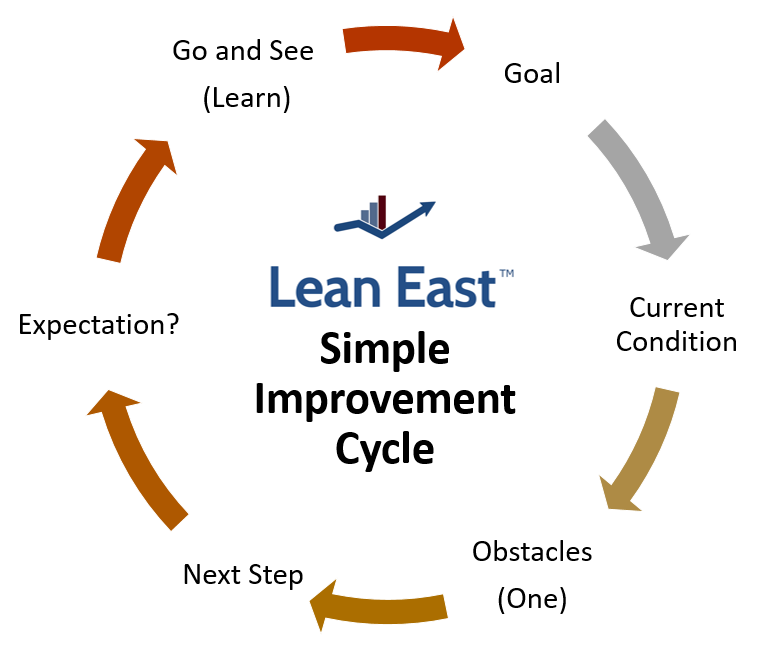
Having a “God complex” is a huge mistake. Instead, leaders must admit that they don’t have all the answers. Both leaders and their teams should focus on data-driven experiments and celebrate their successes, no matter how small.
Summary
Harford’s theory of the “God complex” and the practical strategies of continuous improvement have a powerful synergy. The lesson is clear: to truly innovate and thrive, businesses must abandon the illusion of perfect foresight and expert control. Instead, they must cultivate a humble, adaptable culture — one that, like the engineers at Unilever, is willing to learn from mistakes and allow the best solutions to emerge through the powerful, messy process of trial and error.
We hope you found this TED Talk another “idea worth spreading.” Please leave your questions and comments below.
Related Posts
5 Better Questions to Build a Lean Coaching Habit
Lean AI: How to Integrate Artificial Intelligence Without the Waste
The 5-Minute AI Audit: Where Does Your Organization Actually Stand?