

Harvard Professor John P. Kotter wrote Leading Change in 1996 to provide an action plan for successful organizational transformation. Kotter argues that successful, large-scale change efforts depend on leadership, not just management, and most organizational change initiatives fail not because of poor planning, but because key leadership steps are skipped or mishandled. The core of the book provides an 8-step process for leading change. We will share his process and then compare his original work on leading change to his newest book, Change: How Organizations Achieve Hard-to-Imagine Results in Uncertain and Volatile Times (2021).
Kotter’s 8-Step Process for Leading Change
Kotter’s 8-Step Process for Leading Change is a structured, linear approach designed to overcome complacency and institutional resistance so changes stick. Kotter emphasizes that skipping any of these steps creates the illusion of speed but guarantees failure in the long run. Successful transformation is a multi-year process that requires strong, emotionally intelligent leadership to drive the vision and inspire action, complemented by competent management to handle the planning and logistics.
Establish a Sense of Urgency
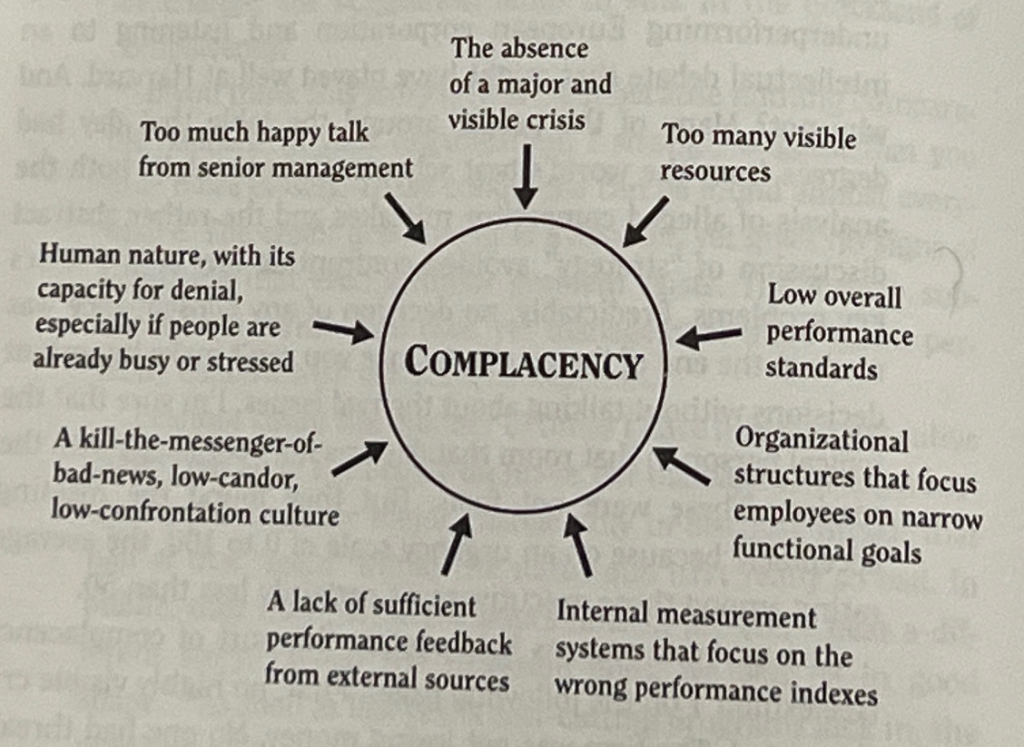
Begin by examining the market and competitive realities to identify potential crises or opportunities. You must overcome the many sources of complacency on your team. Attempt to convince a critical mass of people (at least 75% of management) that the status quo is dangerous or unacceptable.
Sources of Complacency
Create the Guiding Coalition
Assemble a powerful, influential, and diverse group with enough authority, expertise, and credibility to genuinely lead the change effort as a team outside the normal hierarchy.
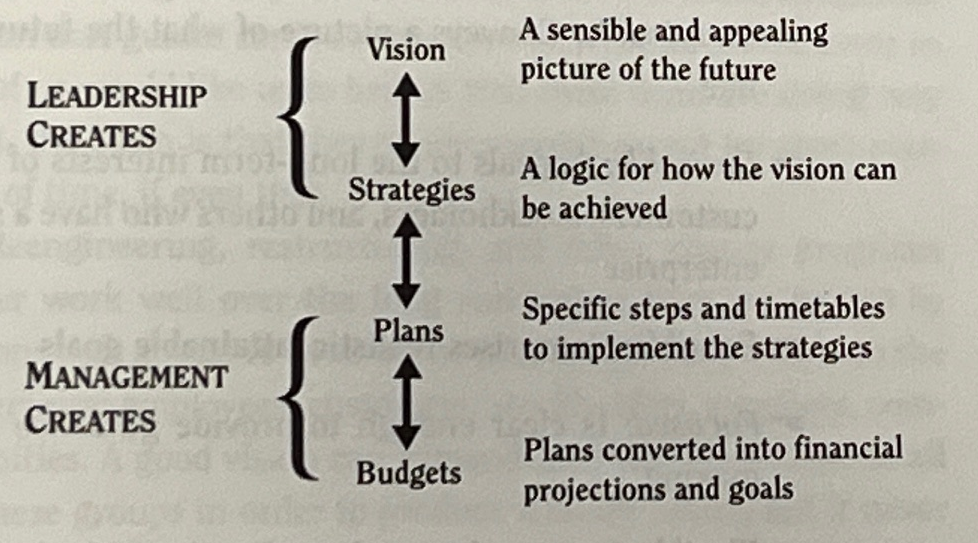
Note how Kotter defines the difference between management and leadership. Management’s goal is to bring order and predictability to a chaotic situation. It is about keeping the current system running efficiently, meeting targets, and producing reliable results (like consistent product quality). Leadership’s goal is improvement. It is about navigating the organization through turbulent times to a new, better future.
Develop a Vision and Strategy
Create a clear, compelling, and easy-to-understand vision of the future, along with strategies to achieve that vision. The vision must be imaginable, desirable, feasible, focused, flexible, and communicable.
The Relationship of Vision, Strategies, Plans, and Budgets
Communicate the Change Vision
Use every communication channel available to widely and frequently transmit the vision. The guiding coalition must lead by example, ensuring its actions are consistent with the vision.
Key elements in effectively communicating the vision are:
- Simplicity (metaphors and pictures help)
- Multiple forums and repetition
- Give and take discussion
- Leadership by example
Empower Broad-Based Action
Remove organizational obstacles, such as restrictive processes, outdated structures, or resistant managers. Encourage risk-taking, non-traditional ideas, and actions that align with the new vision.
The key here is consistency with the vision. You also must ensure that you have a budget and schedule for training people.
Generate Short-Term Wins
Plan for and execute visible, unambiguous, and early successes (within 12 to 18 months). These wins provide evidence that the sacrifices are worthwhile, reward those involved, and help to undermine cynics.

Consolidate Gains and Produce More Change
Use the increased credibility from the short-term wins to change underlying systems, structures, and policies. Do not declare victory too soon; instead, build momentum with more projects, change agents, and an invigorated process.
All leaders must realize that resistance to change is always waiting to reassert itself. Kotter reminds leaders to lead the change and not get caught up in managing the change (review the definitions above).
Anchor New Approaches in the Culture
Ensure the new ways of working and improved results are embedded into the corporate culture. This means articulating the connections between the new behaviors and organizational success, and creating new leadership development and succession plans that reinforce the change.
Here is how Kotter suggested you anchor change in an organization:
- Wait until the end for culture change instead of planning this at the start
- Wait for results that demonstrate the improvement works
- Communication is necessary, and it is hard to overcommunicate
- Leaders must understand that sometimes the only way to change a culture is to change key people
- Ensure promotion practices are compatible with the new practices and culture
Kotter’s 2021 Updates for Leading Change

Kotter (and other members of his team) wrote a follow-up to Leading Change in 2021. Change: How Organizations Achieve Hard-to-Imagine Results in Uncertain and Volatile Times updates Kotter’s change management philosophy for our modern world, where the speed of change is faster than ever. The authors argue that traditional change management is often too slow and rigid and introduce a science-based approach to help organizations adapt continuously.
Here are the major changes in the 25 years between books:
- From “Steps” to “Accelerators.” In Leading Change, Kotter introduced the famous 8-Step Process as a linear recipe. In Change, these 8 steps are reimagined as “Accelerators” and run concurrently and continuously. You don’t just “create urgency” once at the start; you must maintain it constantly.
- From “Managing” to “Science.” Leading Change was based largely on observation and business practice. Change grounds those observations in neuroscience (see our post Leaders Eat Last) and explains why the 8 steps work in our brains by bypassing the brain’s resistance (Survive) and unlocking its potential (Thrive).
- From Episodic to Continuous. Leading Change was often interpreted as a guide for managing a distinct event or project. Change argues that the era of distinct events is over; organizations must now be built for perpetual change, requiring a culture where the “Thrive” channel is always active.
Summary
We encourage any readers who are involved in – or leading – an organizational change initiative to reach out to Lean East for assistance. Organizational improvement is no longer a project; it is now a way of life. Leaders should inspire people through emotion, purpose, and vision (“Head and Heart”) to get them to want to change, rather than just have to. It is wise to add extra resources to maximize your likelihood of success.
Please leave your comments and questions below.
Related Posts
10 Ways to Have a Better Conversation
10 Great Leadership Lessons from Elon Musk II
10 Great Leadership Lessons from Elon Musk