

In our last discussion, we shared an easy way for you to get your Lean AI Score and understand how ready your organization is for an AI revolution. If you’ve taken the time to calculate your score, you likely have a clearer picture of your technical readiness. However, a high score doesn’t automatically translate to a high return on investment. There is a dangerous trap currently catching even the most sophisticated organizations: the rush to automate processes that are fundamentally broken.
The mantra of the Lean practitioner has always been to “simplify, then automate.” In the age of Generative AI, this has never been more critical. If you apply AI to a wasteful process, you don’t eliminate the waste; you simply automate the waste, allowing it to continue at a speed and scale that can eventually cripple your operations.
The Illusion of High-Tech Efficiency

It is tempting to view Artificial Intelligence as a “magic wand” that can be waved over any business bottleneck to make it disappear. We see a manual data-entry task or a convoluted customer service routing system and think, “An LLM or an agentic workflow could do this in seconds.”
Technically, that’s true. But speed is not the same as value.
If a process requires five unnecessary approvals and three redundant data transfers, training an AI to navigate those five approvals and three transfers just makes the dysfunction invisible. You are still paying for the “compute” of those unnecessary steps. More importantly, you are layering complex technology over a foundation of sand. When the underlying process eventually shifts, the automation breaks, and because no one truly understood the Lean version of the task, the repair costs are astronomical.
Why You Must “Lean” Before You “AI”
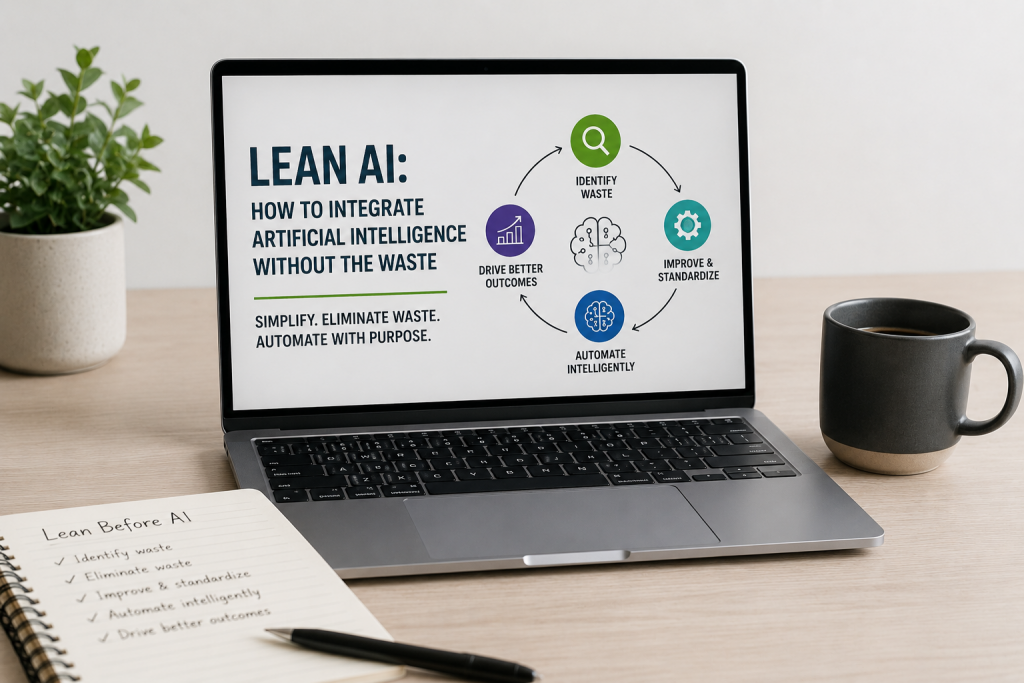
In Lean methodology, we define waste (Muda) as any activity that consumes resources but creates no value for the customer. When we look at process improvement through the lens of AI integration, we must follow a strict order of operations: Identify, Eliminate, Optimize, and only then, Automate.
1. Automating Waste is Expensive
AI implementation isn’t free. Whether you are paying for API tokens, custom model tuning, or the specialized talent required to build “Agentic” workflows, every step in your process has a price tag. If 30% of your current process is waste, and you automate the whole thing, you are essentially paying a “waste tax” on every single transaction your AI performs.
2. Waste Creates “Noise” for the Model
AI models, and especially Large Language Models, rely on clear context and clean data. Wasteful processes are often characterized by redundant information, just-in-case documentation, and circular communication loops. When you feed this “noise” into an AI, you increase the likelihood of hallucinations and errors. A Lean process provides the clean signal the AI needs to be truly effective.
3. Complexity is the Enemy of Agility
The more complex an automated system is, the harder it is to change. By automating a wasteful, multi-step process, you lock that waste into your digital infrastructure. A Lean process is elegant and simple, making it much easier to update as your business needs evolve.
Identifying the 8 Lean Wastes in the AI Era
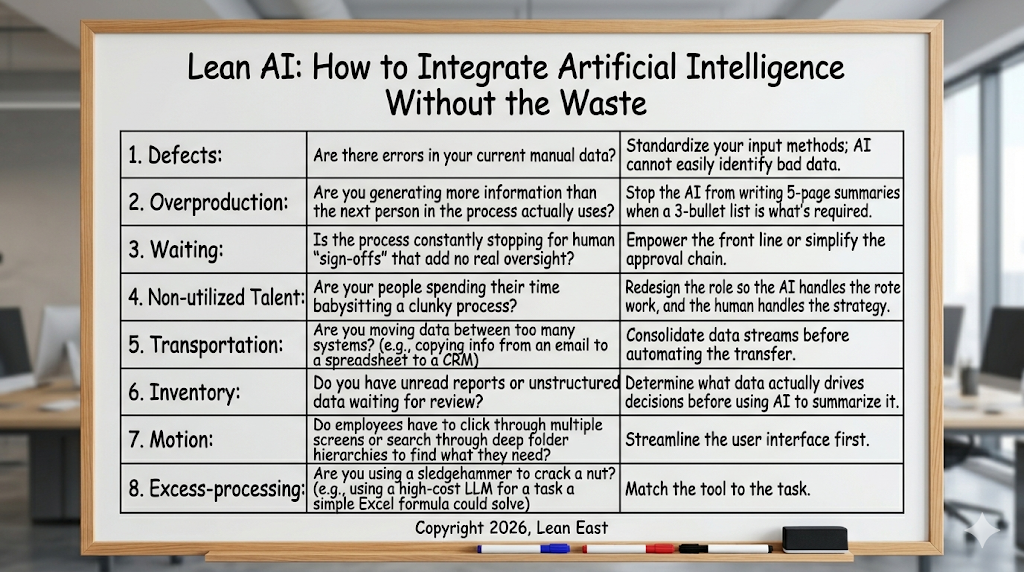
To avoid automating waste, we must look at the traditional 8 Wastes of Lean (DOWNTIME) and see how they manifest in a pre-AI environment. Before you write a single line of code or sign an AI vendor contract, ask if your current process is guilty of the following:
- Defects: Are there errors in your current manual data? Lean Fix: Standardize your input methods; AI cannot easily identify bad data.
- Overproduction: Are you generating more information than the next person in the process actually uses? Lean Fix: Stop the AI from writing 5-page summaries when a 3-bullet list is what’s required.
- Waiting: Is the process constantly stopping for human “sign-offs” that add no real oversight? Lean Fix: Empower the front line or simplify the approval chain.
- Non-utilized Talent: Are your people spending their time babysitting a clunky process? Lean Fix: Redesign the role so the AI handles the rote work, and the human handles the strategy.
- Transportation: Are you moving data between too many systems? (e.g., copying info from an email to a spreadsheet to a CRM) Lean Fix: Consolidate data streams before automating the transfer.
- Inventory: Do you have unread reports or unstructured data waiting for review? Lean Fix: Determine what data actually drives decisions before using AI to summarize it.
- Motion: Do employees have to click through multiple screens or search through deep folder hierarchies to find what they need? Lean Fix: Streamline the user interface first.
- Excess-processing: Are you using a sledgehammer to crack a nut? (e.g., using a high-cost LLM for a task a simple Excel formula could solve) Lean Fix: Match the tool to the task.
The Path Forward: The Lean AI Workflow
How do we actually implement this? At Lean East, we suggest a four-step approach for a Lean AI integration project:
Step 1: Value Stream Mapping
Map your current process from start to finish. Identify every touchpoint, every decision, and every delay. If you can’t draw it on a whiteboard, you shouldn’t automate it with AI.
Step 2: The “5 Whys” of Each Step
For every step in your map, ask “Why is this necessary?” If the answer is “because we’ve always done it that way” or “to fix a bug in the previous step,” you’ve found waste. Delete it.
Step 3: Improve and Standardize the Lean Version
Create a Future State Map for the manual process. Ensure that the inputs are clean and the outputs are valuable. This creates the blueprint (and the training data) for your future AI.
Step 4: Surgical Automation
Now, and only now, apply AI. Use it to bridge the gaps between value-added steps or to accelerate the most labor-intensive parts of the optimized process.
Conclusion: Faster Isn’t Always Better
The goal of Lean AI isn’t just to do things faster; it’s to do the right things with zero friction. When we rush to automate, we often forget that the most efficient way to handle a wasteful step is not to automate it, but to remove it entirely.
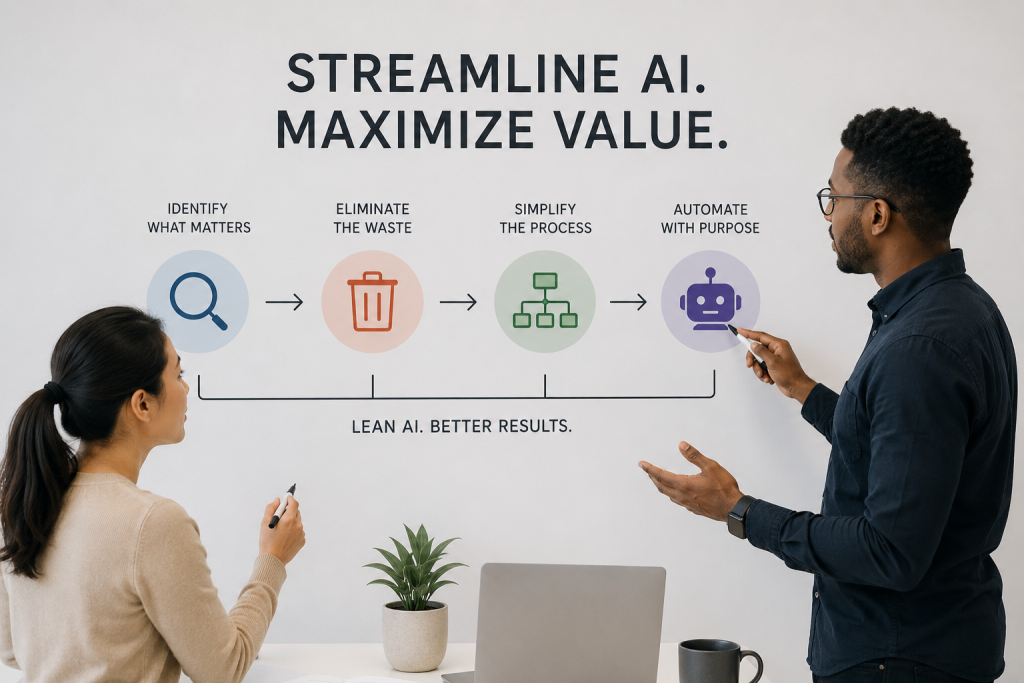
Before you look for an AI solution, look for a Lean solution. Your Lean AI Score will improve not just because you have better tools, but because you have a better process for those tools to amplify.
Remember: Efficiency is doing things right. Effectiveness is doing the right things. AI can help with the former, but only Lean thinking can ensure the latter.
Are you ready to audit your processes before your next AI rollout? Connect with us at Lean East to discuss how we can help you map your value stream and ensure your digital transformation is built on a foundation of efficiency, not automated waste.
Related Posts
5 Better Questions to Build a Lean Coaching Habit
The 5-Minute AI Audit: Where Does Your Organization Actually Stand?
Stop Wasting Time: 5 Lean Strategies for Faster, Smarter Decisions