

Ten years ago, I explored the WRAP process—a powerful four-step framework to fight the villains of decision-making. But in 2026, the pace of work with Lean East’s clients has shown me that quality isn’t enough; we also need velocity. A slow “perfect” decision is often worse than a fast “good enough” one. To bridge that gap, here are five Lean strategies for faster, smarter decisions that help you eliminate decision waste.
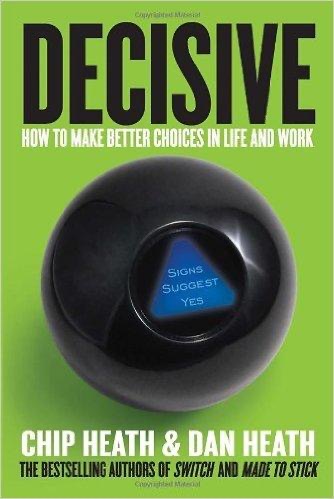
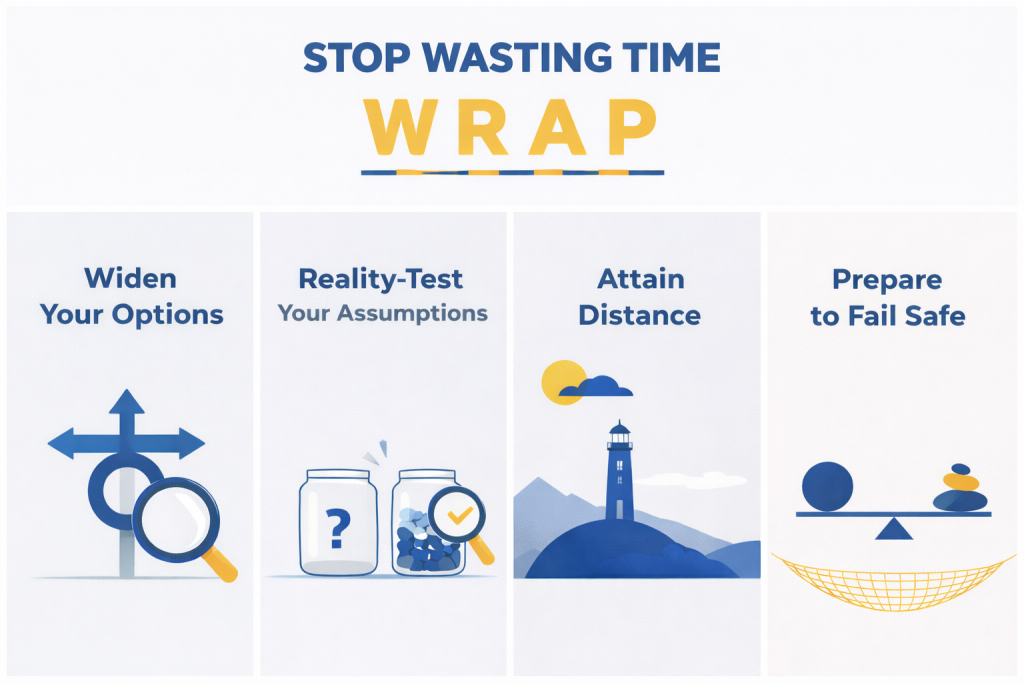
As we begin, please review the WRAP Process introduced by Chip and Dan Heath from their 2013 book Decisive: How to Make Better Choices in Life and Work. The WRAP process has four parts, with each letter representing a simple phrase:
- Widen Your Options
- Reality-Test Your Assumptions
- Attain Distance Before Deciding
- Prepare to be Wrong
Here is how Lean East applies Lean thinking to expand upon the WRAP process for decision-making.
1. Define the Decision, Criteria, and Constraints
This first step is surprisingly a major issue many of us have with decision-making: we don’t take the time to truly define the decision we are making in the first place. For example, let’s assume that your decision is what automobile to buy and drive for the next 5-10 years. Isn’t it true that the decision is really what vehicle to use for transportation now, since transportation is our true need, and we cannot guarantee what will happen in the future?
Next, write down the criteria we will use to make our decision. What factors in this decision are important to us? Which are not? We strongly recommend that you weigh factors as you define them, since some factors will be much more important to you than others.
Finally, as we define the constraints, it is important to be ready to challenge them. This is a perfect time to Widen Your Options (the ‘W’ in WRAP). For the cost constraint, what if you lease or finance the vehicle rather than pay in cash? Do we really need to buy a vehicle, or is using public transportation and ride-sharing an option?
2. Apply the “5 Whys” to Your Options
As you Widen Your Options, check to see if you are looking at symptoms rather than the root cause. Effective Lean process improvement stresses a thorough understanding of the background and current condition before seeking to understand the root causes of the issue. Taking more time at this stage will help you to identify new options.
One of our Lean tools for root cause analysis is asking the 5 Whys. Before deciding on a solution, ask “Why?” five times to ensure you are solving the right problem and to help uncover new options for your decision.
Making good choices relies on forecasting the future, and accurate forecasting requires exposing ourselves to as many successes and disappointments as possible. You must learn from both the upside and downside possibilities. It is important to understand the “prior” or “base rate” when predicting the likelihood of any outcome, so you don’t fall into the trap of common biases. Learn more about forecasting potential futures and dreaming up better possibilities of what might occur here.
3. Standardize Your Decision-Making Process
Lean thrives on predictability. If every decision is a “special case,” you waste energy reinventing the wheel. Instead, standardize your decision-making process. We suggest you always begin by setting up a simple Decision Matrix to help define the criteria and evaluate your options.
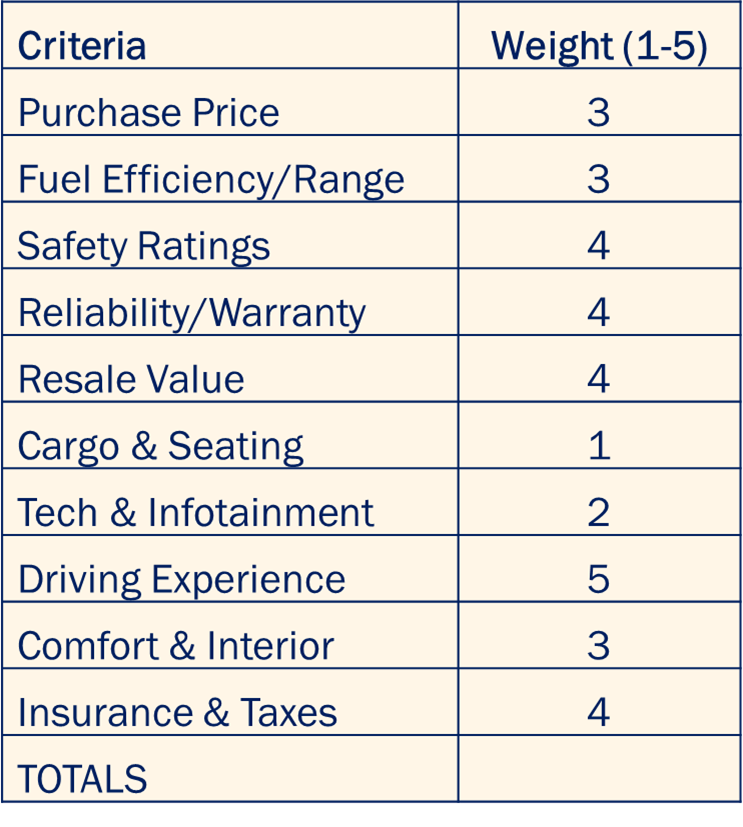
Here is a simple Decision Matrix for purchasing a new automobile. In it, we have defined the criteria we are using to make our decision and assigned weights to the criteria. For this matrix, “Driving Experience” is the most important factor, while “Cargo & Seating” made the list but is a much less important factor. This driver didn’t bother to include additional possible criteria, such as “Image enhancement” or “Audio System,” that might be important to you. The criteria you choose and the weights you assign are personal.
By explicitly listing and weighting the criteria, you move the decision out of the realm of intuition and into a measurable, objective framework. This transparency prevents the common decision waste of endless, unstructured debate, ensuring that all stakeholders are evaluating options against the same agreed-upon standard.
4. Identify and Eliminate Decision Muda
Once you have a decision matrix defined, it is time to evaluate options. But how many should you examine?
Barry Schwartz’s The Paradox of Choice challenges the conventional wisdom that more options lead to greater freedom and satisfaction. In reality, an abundance of choices often leads to anxiety, indecision, and regret.
Your next step should be to reduce the hundreds of options available down to just three or four. Add these three or four options into your decision matrix and complete the analysis by scoring each criterion from 1-10 and then multiplying by the “weight factor” you assigned.
In Lean, Muda is anything that doesn’t add value. A major source of muda in decision-making is over-analyzing trivial choices or waiting for “100% certainty” that will never come. Instead, use the 70% Rule. Jeff Bezos famously noted that most decisions should be made with about 70% of the information you wish you had. If you wait for 90%, you’re likely being slow.
5. Test Your Decision
Our final Lean strategy for a smarter, faster decision is to “pause” after making your decision and reconsider the WRAP process:
- Is there a way to Reality Test your decision? Did you read the reviews? Do you have any friends who have made the same decision in the past? Can you trial before buying? When buying a car, now would be a good time to test drive your final option.
- While you take a moment for the reality test above, use the opportunity to Attain Distance Before Deciding. Sleeping on your decision and sharing it with others can provide a final sanity check.
While this reality test and pause leads to a short delay in the decision process, we are confident it will help you move forward with more confidence and no regret.
Conclusion: Move from Decisive to Lean
By defining the decision and criteria, getting to root cause, standardizing your process, minimizing analysis paralysis, and testing your decision, you can make high-quality decisions at the speed required for 2026. Use these steps for your next big decision and then share the results with our team.
Do you have additional suggestions? Please leave your comments and questions below!



Steve – great post. FWIW, in several roles (at a few different companies) I used “vision, velocity and value” as grounding principles for how we wanted to work, and would often comment to folks in presentations “for the engineers in the room”, to remember that velocity is a vector, representing both speed and direction. I was always pleasantly surprised at how quickly people grasped the idea that speed alone can be a problem, understanding that the choice of direction is very much complementary to the process and a driver of positive outcomes.