

Over the past ten years, I have taught hundreds of leaders how to develop scientific thinking using Lean Kata. Professor Mike Rother’s coaching kata cards are a simple and effective way to help leaders develop a coaching habit. The Lean coaching kata helps leaders coach their people in a scientific way of thinking and acting. Lean thinking requires respect for people. One of the best ways to demonstrate respect is to help those closest to the action develop their own solutions to problems and increase customer value.
The coaching kata requires leaders to ask the following five questions to the individuals and teams they are coaching:
- What is the target condition?
- What is the actual condition now?
- What obstacles are preventing you from reaching the target condition? Which one are you addressing now?
- What is your next experiment? What do you expect?
- How quickly can we go and see what we have learned from taking that step?
Here is the Kata card I have shared for the past ten years:
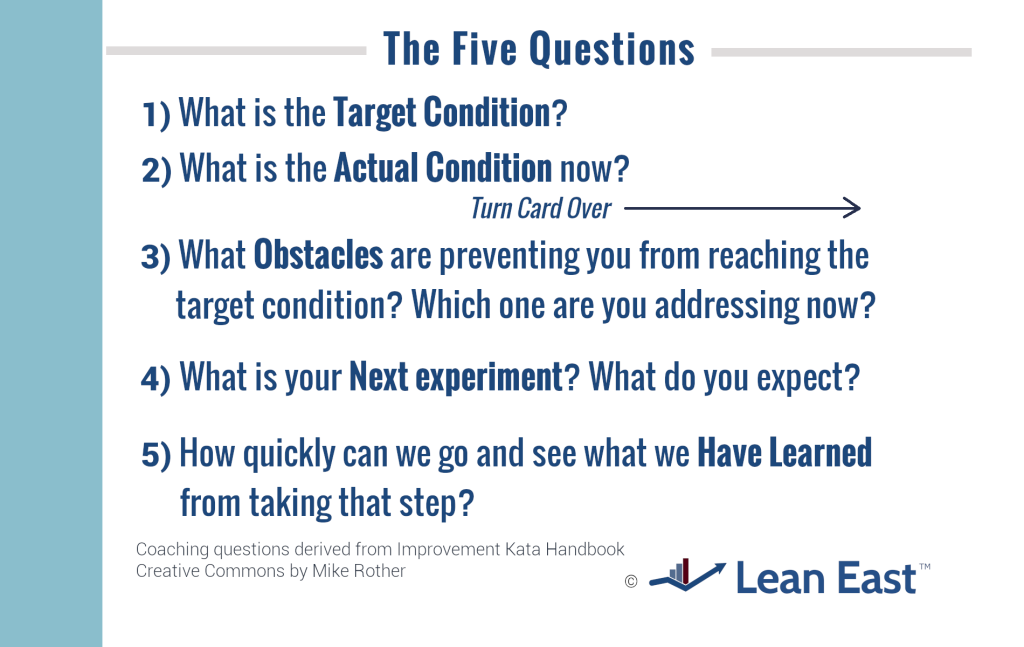
I always found these questions awkward to ask as written (unless you are a data scientist) and naturally adapted Rother’s language for my own coaching conversations. When I watched my learners struggle with the same language at a recent training session, I knew it was time to move away from Mike Rother’s questions to something more accessible for the typical leader. I leaned on another training resource we use in our My Leadership Journey program for support.
The Coaching Habit: Seven Questions That Can Change How You Lead
Michael Bungay Stanier’s The Coaching Habit is one of the most practical books on leadership coaching you’ll find. Rather than turning managers into therapists or requiring extensive training, it offers something more useful: seven questions to ask more and talk less.
The premise is simple: most leaders jump too quickly into advice-giving mode, which keeps their teams dependent and leaves real problems unsolved. By learning to stay curious a little longer, leaders create space for the people around them to think more clearly, own their work more deeply, and grow faster.
The Seven Coaching Questions
Michael Bungay Stanier (or MBS, for short) suggests leaders use these seven coaching questions in any conversation with a person you lead. Your job as a servant leader is to help the person you are coaching to grow. These simple questions help structure the conversation so it is useful.
1. “What’s on your mind?” (The Kickstart Question)
This question cuts straight to what matters. Instead of small talk or an open-ended “how can I help?”, it invites the other person to bring up whatever is most pressing for them right now. It signals that you’re present, that this conversation has purpose, and that the other person gets to set the agenda. For leaders, it’s a powerful way to start any check-in without assuming you already know what someone needs.
2. “And what else?” (The AWE Question)
The first thing someone says is rarely the most important thing. This deceptively simple follow-up opens the door to what’s really going on beneath the surface. It slows the conversation down, discourages leaders from latching onto the first answer and running with it, and often uncovers the issue that was waiting to be named. Used two or three times in succession, it’s one of the most effective coaching moves in the book.
3. “What’s the real challenge here for you?” (The Focus Question)
People often present a surface-level problem when the actual challenge is something deeper or more personal. This question does two things: the word “real” signals that you’re not satisfied with a superficial answer, and the phrase “for you” makes it personal — it acknowledges that the challenge exists in the context of this specific person’s situation. It helps both the coach and the person being coached resist the urge to solve the wrong problem.
4. “What do you want?” (The Foundation Question)
This question sounds almost too simple, but it’s one of the hardest for people to answer clearly. Most people have a vague sense of what they need from a conversation but haven’t made it explicit, even to themselves. Asking directly creates clarity and prevents the conversation from wandering. It also builds a habit of helping people articulate their own needs rather than relying on you to figure it out for them.
5. “How can I help?” (The Lazy Question)
MBS calls this the “Lazy Question” not because it’s easy, but because it forces the other person to make a specific request rather than leaving you to guess. Without this question, leaders often over-help, taking on problems that aren’t theirs to solve. When someone makes a concrete ask, you get to respond to what they actually need, not what you assume they need. It’s a critical check against the well-meaning leader who takes on too much.
6. “If you’re saying yes to this, what are you saying no to?” (The Strategic Question)
This is the question that creates accountability around priorities. It surfaces the real cost of a commitment in time, focus, energy, and what gets left behind. For leaders and their teams, it’s a way to have honest conversations about capacity and trade-offs before problems emerge. This question is especially important in a culture that rewards saying yes to everything.
7. “What was most useful for you?” (The Learning Question)
The final question closes the conversation in a way that locks in learning. Rather than summarizing what you think happened, it asks the other person to name what they’re taking away from the coaching conversation, which reinforces their ownership of the insight. It also gives you real-time feedback on whether the conversation was actually valuable. Over time, it builds a culture where reflection is a normal part of every interaction, not an afterthought.
Improving the Lean Coaching Kata Questions
I decided to use MBS’s 7 questions as inspiration for a revamped version of the Lean Coaching Kata questions. Here are my updated questions:
- What do you want to accomplish?
- What is happening right now? What data shows this?
- What’s in the way? Which obstacle are you tackling now?
- What will you try next? What do you predict will happen?
- When can we go and see what we learned from the last step?
And here is my updated Lean Kata card:
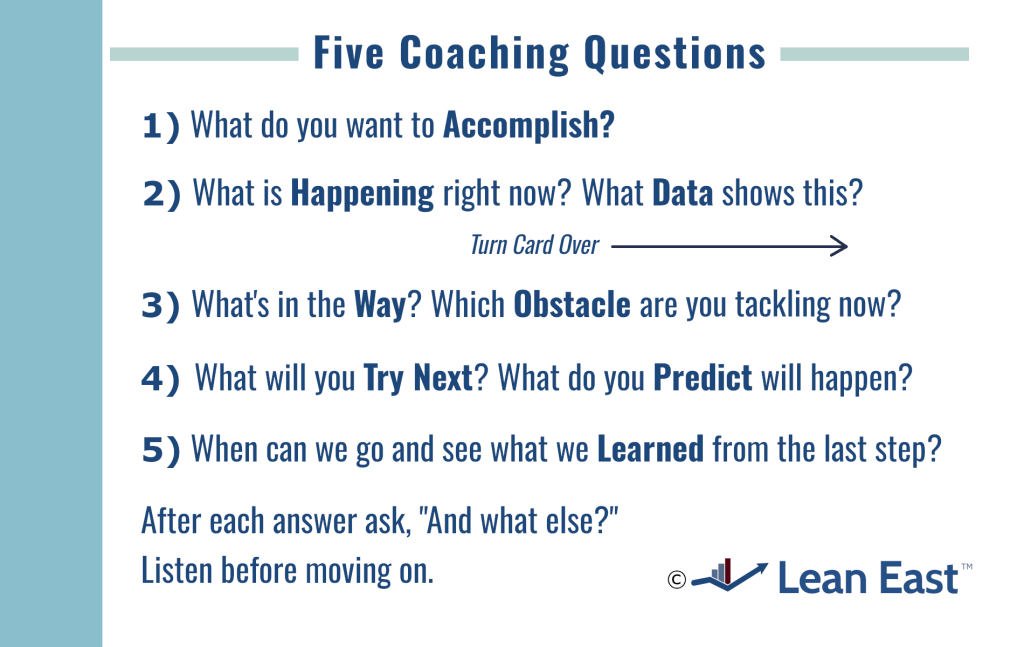
I tried to maintain Rother’s original intent of building a habit of scientific thinking. The question asking, “Which obstacle are you tackling now?” implies you are focused on one experiment from your list to try next. The question asking, “What do you predict will happen?” still requires the learner to develop a hypothesis and learn from the test.
Do you like my changes? Please let me know in the comments below, preferably before I send these new cards off to my printer!
Related Posts
Lean AI: How to Integrate Artificial Intelligence Without the Waste
The 5-Minute AI Audit: Where Does Your Organization Actually Stand?
Stop Wasting Time: 5 Lean Strategies for Faster, Smarter Decisions