

Earlier this year, we shared 5 Lean strategies for faster, smarter decisions. Since then, leaders I work with aren’t asking how to make decisions. It’s when. Their calendars are full, yet decisions still arrive late. One-on-one meetings get pushed. The monthly project review uncovers a problem that started six weeks ago.
In most cases, the issue isn’t the number of meetings. It’s the rhythm. Lean has a name for a rhythm that matches demand: takt time. Here is how Lean East applies takt thinking to the meeting rhythms you set for huddles, one-on-ones, project reviews, and beyond.
Takt Time in 60 Seconds
“Takt” is German for a precise interval of time, like the beat in a piece of music. Takt time is calculated by taking your available production time and dividing it by customer demand. If a factory runs 480 minutes a day and customers want 240 units per day, the takt time calculates to two minutes. Therefore, one unit should be completed by the process every two minutes to meet demand.
Produce faster than takt, and you build inventory nobody needs yet. Produce slower, and customers wait, overtime grows, and everyone starts expediting. Takt isn’t about speed. It’s about matching the pace to demand.
Translating Takt to Your Meeting Rhythm
Every recurring meeting is a process, and every process has a customer. The customer of a one-on-one is the individual team member, and the customer of a project review is the project team and its sponsor. The customer of a daily huddle is the frontline team trying to get today’s work done.
Each of these customers has a demand: decisions to be made, feedback to be given, obstacles to be removed. Meeting takt asks a simple question: How often does this work actually generate something that needs a conversation?
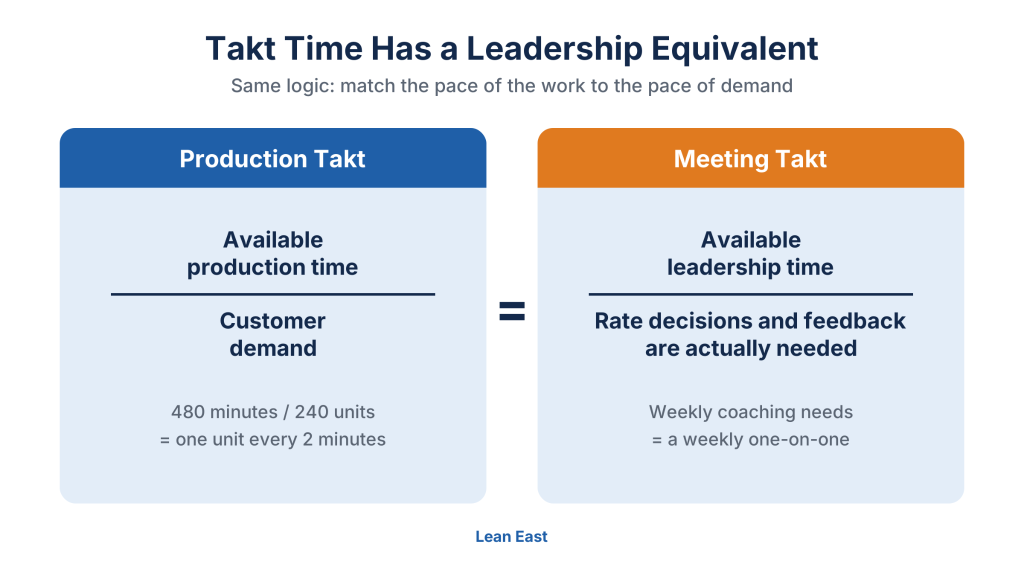
Match your meeting rhythm to the rate decisions and feedback are needed.
You won’t calculate meeting takt to the minute, and you shouldn’t try. The analogy works only if you name the customer and the demand for each meeting. A meeting with no clear customer has no takt, and that is usually your first clue it shouldn’t exist.
When Your Cadence Runs Faster Than Demand
Taiichi Ohno considered overproduction the worst of the Eight Lean Wastes because it hides all the others. Meetings scheduled faster than demand are overproduction for leaders. You’ll recognize the symptoms:
- The same status updates are repeated week after week
- The agenda is recycled because nothing has changed
- People spend hours preparing slides no one reads
- Attendees quietly hope the meeting gets cancelled
The cost isn’t just the hour in the room. It’s the context switching, the prep time, and the lost focus on the value-adding work between meetings. Learn more about this kind of hidden waste in our post on Muda, Mura, and Muri.
When Your Cadence Runs Slower Than Demand
The opposite problem is batching. When meetings run slower than demand, issues queue up between them like work-in-process inventory. The symptoms:
- Surprises at the project review that started weeks earlier
- Decisions made in hallways and side messages that bypass the system
- One-on-ones that become venting sessions because a month of frustration arrives at once
- Leaders stuck in firefighting mode
A monthly one-on-one for a new supervisor is a batch of four weeks of feedback delivered in thirty minutes. By the time the coaching arrives, the moment for it has passed.
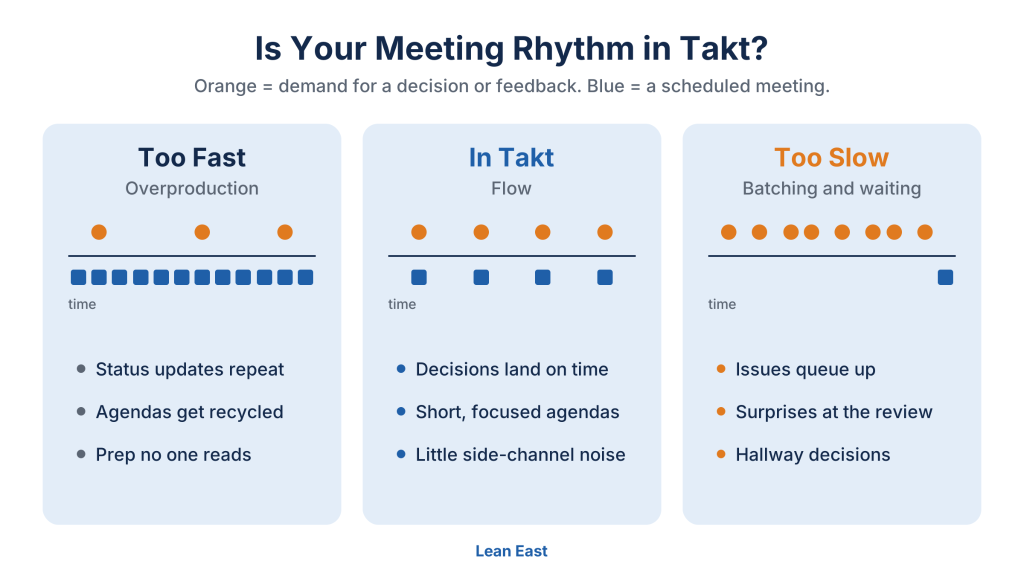
A cadence that runs too fast creates overproduction. Too slow creates batching and waiting.
Setting the Beat by Meeting Type
The right cadence depends on how fast the underlying work changes and needs a decision.
Here is where we suggest most organizations start:
- Daily huddles (10 to 15 minutes): In takt for operations-heavy teams where today’s problems differ from yesterday’s. If nothing much changes from day to day, try moving these meetings to three times a week.
- Weekly one-on-ones (30 minutes): In takt for most team members, because coaching works best in short cycles. Our 5 Better Questions to Build a Lean Coaching Habit will make these conversations count. For experienced people in stable roles, biweekly may be in takt.
- Bi-weekly project reviews: Match the review to the project’s milestone or sprint rhythm. If projects need decisions weekly, tighten it.
- Monthly operating reviews: In takt for KPIs that move monthly. Reviewing them weekly usually means reacting to noise.
- Quarterly strategy reviews: In takt for strategic priorities and resource allocation.
Toyota typically reviews its production takt monthly and fine-tunes it in between. Do the same with your meeting rhythm. A team in the middle of a major launch needs a faster beat than the same team six months later.
Use Pitch and Heijunka to Level the System
Two more Lean concepts turn your meeting rhythm into a system rather than a list.
Pitch is takt multiplied by a pack-out quantity: the regular interval at which leaders check flow. For meetings, think of it as sequencing. Daily huddles feed weekly team meetings, which feed biweekly project reviews, which feed the monthly operating review. When the tiers are in sequence, issues escalate up within a day, and priorities cascade down just as quickly.
Heijunka means leveling the load. Many leaders stack every one-on-one and review on Monday, then become the bottleneck for the rest of the week. Spread recurring meetings across the week and protect blocks of time for the work itself.
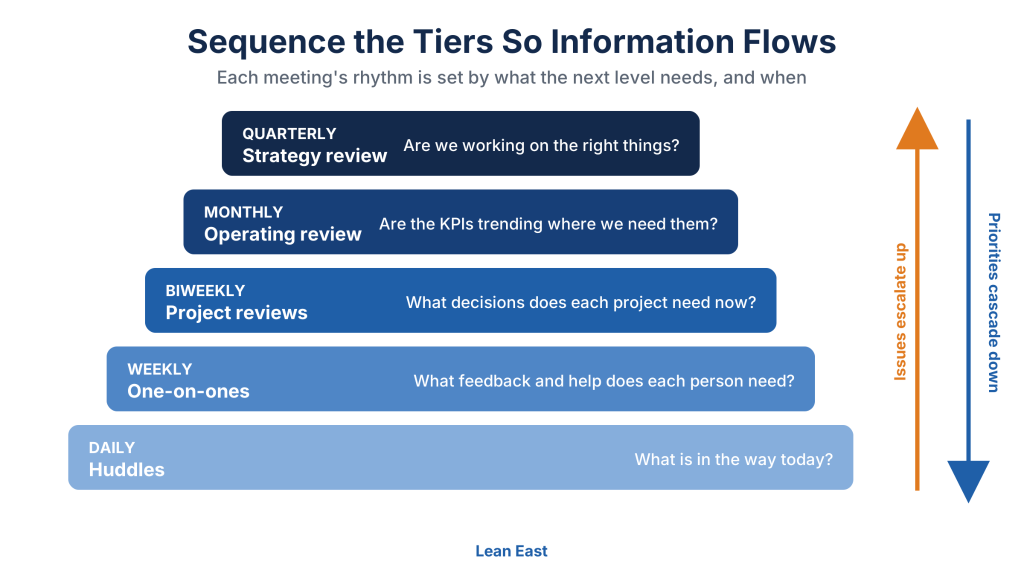
Sequence your meeting tiers so issues escalate up and priorities cascade down.
Try This: A 30-Minute Meeting Takt Audit
- List every recurring meeting you lead or attend.
- For each meeting, name its customer and the demand it exists to meet.
- Estimate how often that demand actually occurs.
- Compare that to the current cadence. If the meeting runs faster than demand, stretch it, shorten it, or replace it with a written update. If it runs slower, tighten it or add a short check-in.
- Check the sequence and the load. Do the tiers feed each other, and is the week leveled?
- Run the new rhythm for 30 days, then adjust using Plan-Do-Check-Adjust.
Conclusion: Lead to the Beat
Takt keeps a production line from overproducing and from starving. Meeting rhythm does the same for your leadership system. Every meeting on your calendar already has a cadence. The only question is whether you set it on purpose to match demand, or whether habit set it for you.
Run the audit above on your current meetings this week and share what you changed in the comments below. If you would like help designing a meeting system for your team, connect with us at Lean East.
Related Posts
The Batching Trap: 3 Ways It Feels Efficient but Isn’t
5 Better Questions to Build a Lean Coaching Habit
Lean AI: How to Integrate Artificial Intelligence Without the Waste